You usually don’t start shopping for heatmaps and session replay because it sounds fun. You do it because a funnel step drops, support tickets spike, or a new UI ships and metrics get noisy, but the dashboards won’t tell you why.
Disclosure: We build FullSession, a behavior analytics platform that overlaps with Hotjar. That also means we spend a lot of time inside Hotjar, testing its features, tracking packaging changes, and hearing where teams stay happy or hit limits.
This review covers what Hotjar does well (and where it’s genuinely a great fit), where it tends to break down as traffic and stakeholders grow, and a practical way to decide whether you should stay, upgrade, or evaluate alternatives.
Written by: Mohamed Sehwail. Reviewed by: Roman (CEO, FullSession). Last reviewed: March 2026.
Quick takeaway: Hotjar in 2026
Hotjar is a strong web-first toolkit for heatmaps, session replay, and lightweight on-site feedback. The main trade-off is scale: daily session capture limits can force sampling, and costs can rise as you add modules. Use the “Should you switch?” section below to decide whether to stay, upgrade, or shortlist alternatives.
Hotjar is one of the tools we’ve analyzed. Today, we are happy to share our in-depth Hotjar review. Check it out, and feel free to share your thoughts with us!
Track How Users Interact with Your Website
Hotjar is a web analytics tool that helps you understand user behavior on your website and identify usability issues. It was created to remove the guesswork from creating a website or landing page.
Hotjar captures all of the user actions and saves them in a database. It provides instant visual feedback that helps you see what your real users are doing, why they come to your website, and how they interact with it.
The goal is to help you make informed decisions to improve the customer experience and ultimately reach your business goals.
For example, Hotjar might record the following user actions:
- Clicking on a link to another page within your site
- Clicking on the back button and moving backward through your website
- Scrolling down or up on a long webpage, such as an article page
- Moving the mouse over a link on your page
- Clicking or tapping on images, buttons, and other interactive elements
It complements traditional analytics tools such as Google Analytics (check out our review of Hotjar vs Google Analytics for more details), helps you track user sessions in real time, and gives you a full picture of the user journey.
If you want to know how Hotjar compares with other web analytics tools, you can also read our Hotjar alternatives review.
Understand Your Site Visitors with Hotjar
Hotjar is a quick and easy-to-use tool. It is suitable for beginner-level users, but advanced digital marketers can use it as well as an addition to their marketing analytics software.
Hotjar’s user-friendly interface and visual representation of the data it provides help you understand why your users behave as they do.
The downside of this solution is that it can get pretty pricey once you upgrade to higher plans, and the basic plan is relatively limited. For most businesses, upgrading will become a must once your business scales up.
Also, some users may find it difficult to use some of the features. Luckily, Hotjar provides guides, tips, and tutorials to help you overcome these challenges.
Exactly What You Can Do with Hotjar
Businesses that have implemented Hotjar use it to acquire, convert, retain, and grow their audience. It offers a set of features that allow you to know your audience better.
Using Heatmaps, Forms, Visitor Recordings, Funnels, Polls, and Surveys, you can receive high-quality feedback regarding your website’s features, features that are trending, and overall user experience without having to worry about the technical side of things.
Make good design decisions with Hotjar
Hotjar is a good tool for speeding up and streamlining the usability testing process. It is a great option not only for small and medium-sized companies but also for startups!
It is a good solution for your business if you have:
- Product team
- Design team
- UX team
- Digital marketing team
- Support team
What made Hotjar different
While Hotjar’s competitors, such as Smartlook or Crazy Egg, have started to release similar features, Hotjar was the first to offer session recordings, combined with many feedback collection features from the CRO platform that allow you to see what you need to improve in your product or multiple sites.
Hotjar also provides feedback regarding lead generation, user engagement, sales, and customer support. These are all actionable insights that are vital to an online business’s success.
In summary, Hotjar is a web analytics tool with many features, an intuitive interface, and a fair pricing structure. Let’s discuss each feature to see how it can improve your web app.
1. Heatmaps
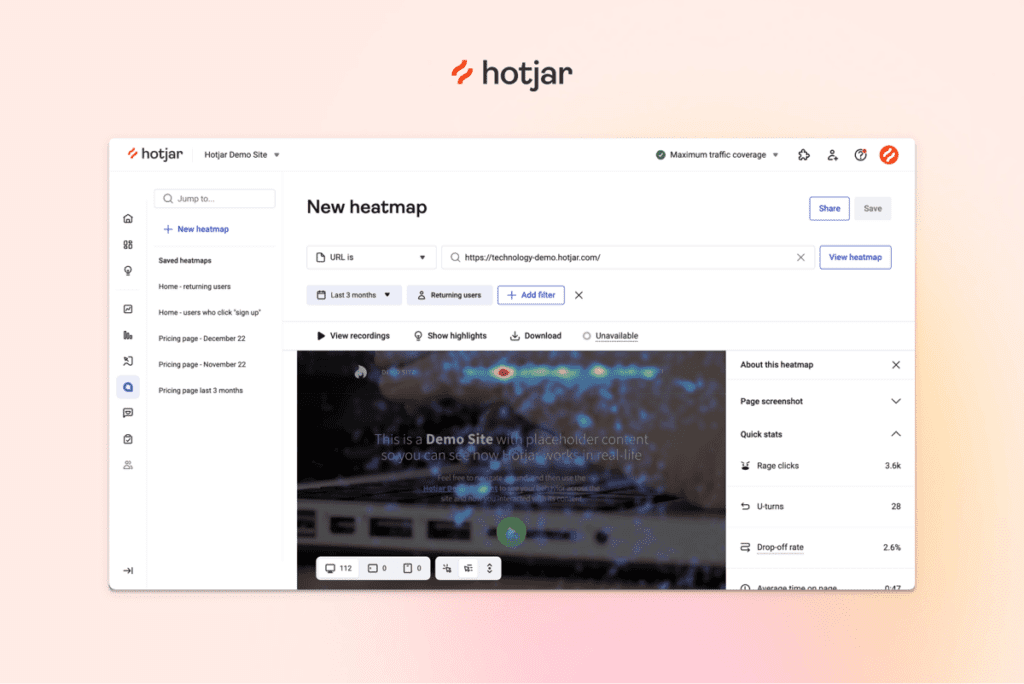
Image source: G2
By using Hotjar heatmaps, you can identify which page elements are catching your users’ attention. Hotjar heatmaps also track where your users scroll or click on the individual page and their mouse movements.
The software gathers data based on the user’s interactions with your site on any device and presents it visually. Analyzing this data will show where you need to make page elements, layout, or content changes to improve the customer journey.
You can also share this data with your team members for further analysis. By implementing corrective measures, you will improve your sales funnels and create high-converting landing pages or websites.
Hotjar heatmap feature lets you know:
- If a user is not able to find a specific feature
- If key elements of your web page are not accessible
- If users aren’t scrolling to key sections
- If users click on your CTA
- If a specific feature is confusing your users
Hotjar tracks your users’ behavior anonymously. You can see how visitors move through your site and what they spend the most time on, but you will never find out their names or anything that could identify them.
This way, Hotjar protects user privacy while still giving you the information you need to improve your web app.
2. Visitor recordings
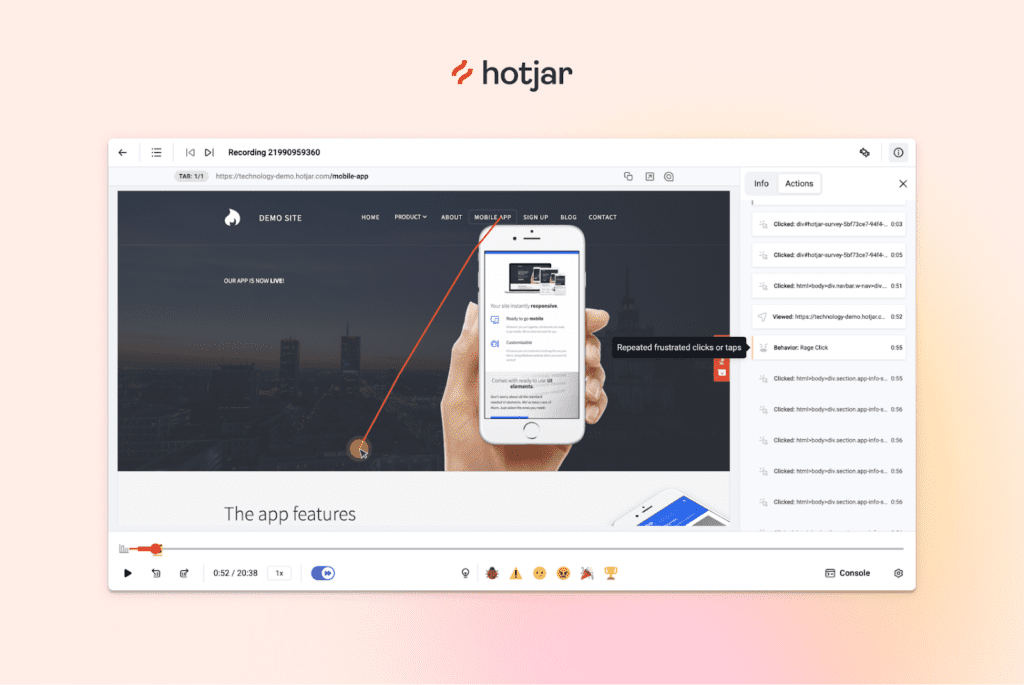
Image source: G2
How can you ensure that your site is working well? Visitor recordings will tell you. This feature allows you to see clicks, scrolls, and mouse movements during real user sessions. With user behavior analysis, you can identify usability issues and fix them to avoid future headaches.
Video recordings help you see exactly what is happening during visitor sessions. You can use the replay sessions feature to pinpoint any specific problem on individual pages or multiple websites.
Also, Hotjar makes it easy to share or download session recordings and their metadata as a CSV or XLSX file. In addition, you can also take notes on visitor recordings to provide feedback and share them with your team members to improve collaboration while working on the same project.
Comparing Hotjar with FullSession
If you’re shortlisting tools, focus on workflow fit: capture limits and sampling, privacy controls, performance overhead, and how quickly your team can go from “issue” to “fix.”
Hotjar offers data retention for up to a year. It is a good option if you want to know what’s happening on your website for a long period.
Visitor recordings are one feature that we’ve polished in FullSession. Unlike Hotjar, it doesn’t slow down your website, apart from advanced filtering options and in-depth analytics.
As you may know, loading speed is a ranking factor for Google, so keeping your website fast and furious is one of our priorities. Book a demo and see it!
3. Conversion funnels
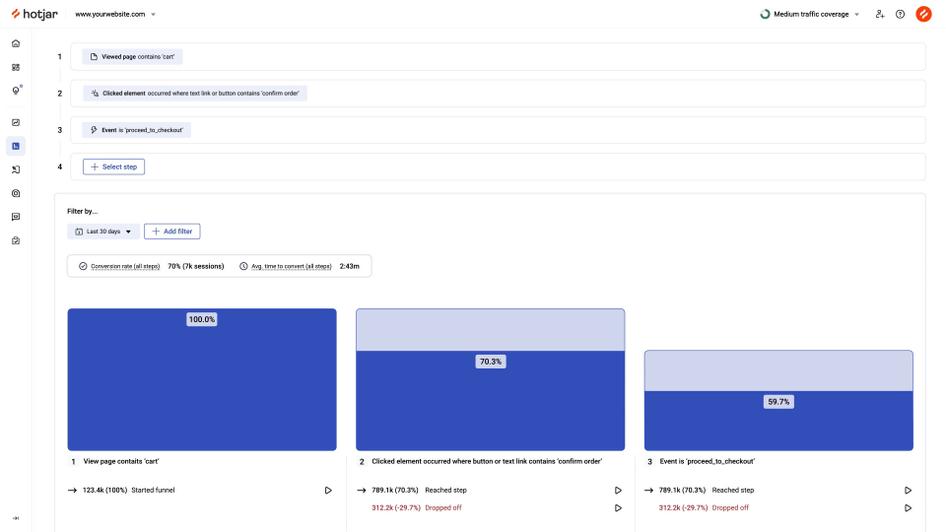
If you run an e-commerce site, funnel testing can help you determine how easily your users can complete the checkout process.
It can show you where your users drop off on your landing page or website and which page elements are more or less effective. Helping your users reach their goals, you are reaching your goals, too!
One of the best ways to improve your conversion rate is to conduct A/B testing on your landing pages, websites, and conversion funnels. A/B testing can help you determine what elements work best for your product or service.
Data will help you optimize your landing page or site to attract more visitors who will sign up for your email list, buy your product, use your service, or take any other action you want them to take.
4. Form analytics
The first step to fixing any problem is identifying the problem. Hotjar includes form analytics as part of its conversion rate optimization platform so you can see how your potential leads are interacting with your forms, how long they are taking to fill them out, and where they are having issues that lead to decreased conversion rates.
With its form analysis feature, Hotjar will provide a basic visual report and give you data on successful or unsuccessful submissions.
If you want to dig deeper into your user interaction data with forms, you can’t do that with Hotjar. One of the disadvantages of Hotjar is that it doesn’t provide in-depth form analysis, and it doesn’t let you split data by date ranges.
If you need this type of information, you’ll have to turn to more advanced analytics tools.
5. User feedback polls
Why do people take certain actions on your website? The best way to find out is by using feedback polls.
Feedback polls are a great way to generate feedback forms and let your users leave feedback directly on your website or landing page.
When users scroll, click, or tap on your website, you can show them your feedback polls as pop-ups. This way, you can allow your users to give you feedback easily, and you can incorporate this feedback into the next iteration of your website or landing pages.
6. Incoming feedback
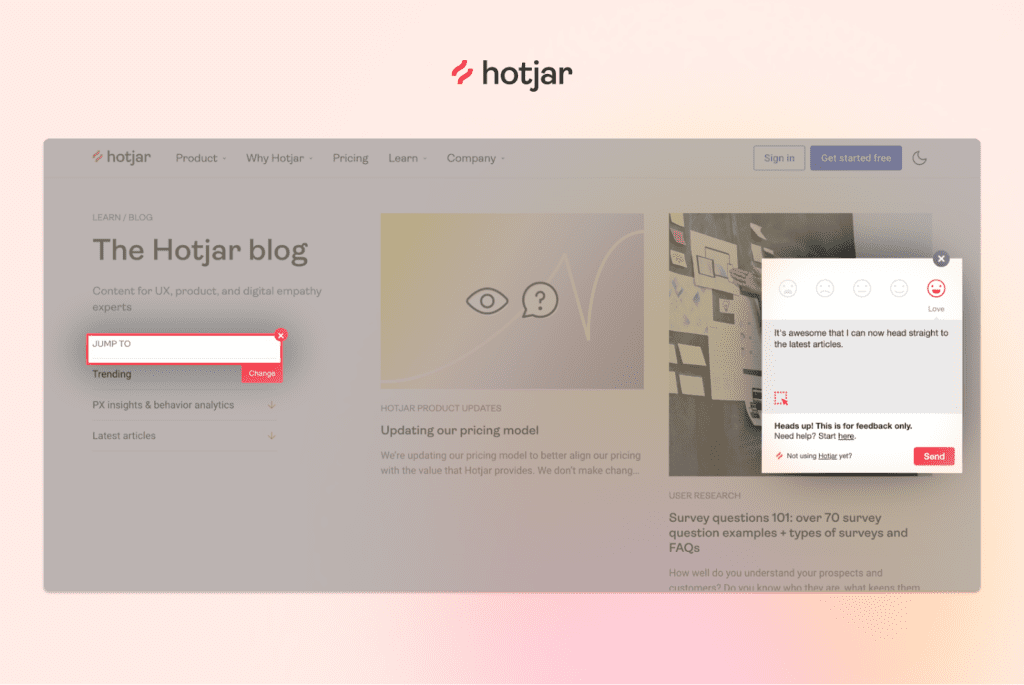
Image source: G2
Feedback is a significant part of any project, but unfortunately, it can be hard to get sometimes. That’s why it’s vital to always make yourself accessible to your users. One way to do this is by adding the Incoming Feedback widget on any page of your website.
You can place an incoming feedback widget on your website to allow users to share their opinions in real time. This will help you learn how they feel when they use your web app.
Incoming feedback will help you collect actionable data about how they are engaging with your website, what they are responding to, and what elements they are ignoring. This information will help you improve your conversion funnels and increase your conversion rate.
7. Surveys
Hotjar Survey is a very helpful feature for SaaS companies. These surveys allow you to ask your site users any questions to get the information you need. You can also survey an unlimited number of respondents. Later, you can see the survey results in Form Analytics.
Surveys can take many different forms: they can be part of your web page, appear in a pop-up, take over the whole screen, or even appear externally.
You can ask multiple questions in one survey, allowing users to focus on one question at a time and give them enough time to type their responses. Also, if you are using Hotjar’s Business plan, you can customize the look and feel of your surveys.
8. User testing recruitment
Recruiting user testers is an easy and non intrusive way to get meaningful user feedback. Your customers will be pleasantly surprised to learn that you’re asking them to share their thoughts and opinions about your site, and the Hotjar widget allows them to sign up effortlessly.
They can also remove the widget if they want to.
9. Other features
Hotjar is more than just a heatmapping tool. It contains many features you can use to improve your website. Below are some of Hotjar’s other less-known features. You can:
- Invite multiple team members or clients without additional fees
- Use different options for targeting visitors
- Collect feedback in more than 40 languages
- Test your website across all device types
- Feel safe because your privacy is secured
- Export and share feedback in CSV or XLSX
- Easily install the Hotjar script
- Integrate Hotjar with other tools
FullSession’s Lift AI stops the analysis paralysis.
Lift AI ranks recommendations per goal & funnel, predicts lift and automatically determines the best testing window.
Compare and Contrast: Hotjar vs Google Analytics
You can use both tools to measure website traffic and visitor engagement. They have some similarities; however, some differences between these two solutions may be important to consider.
Google Analytics collects raw data about your visitors, while Hotjar captures visitor behavior visually.
Hotjar is a popular tool for tracking visitors on your website. It’s great for understanding which pages and areas of your site convert visitors into customers the most effectively.
GA gives you detailed information about your website’s traffic. It shows you how many visitors came to your site, what pages they visited, and where they spent the most time.
Both tools are good at giving you valuable information about your website’s visitors. However, if you want to understand the behavior of your website’s visitors in more detail, then Hotjar is probably a better choice for you.
If you want to learn more about the differences between these two solutions, you can read our full Hotjar vs. Google Analytics review.
Hotjar Pricing
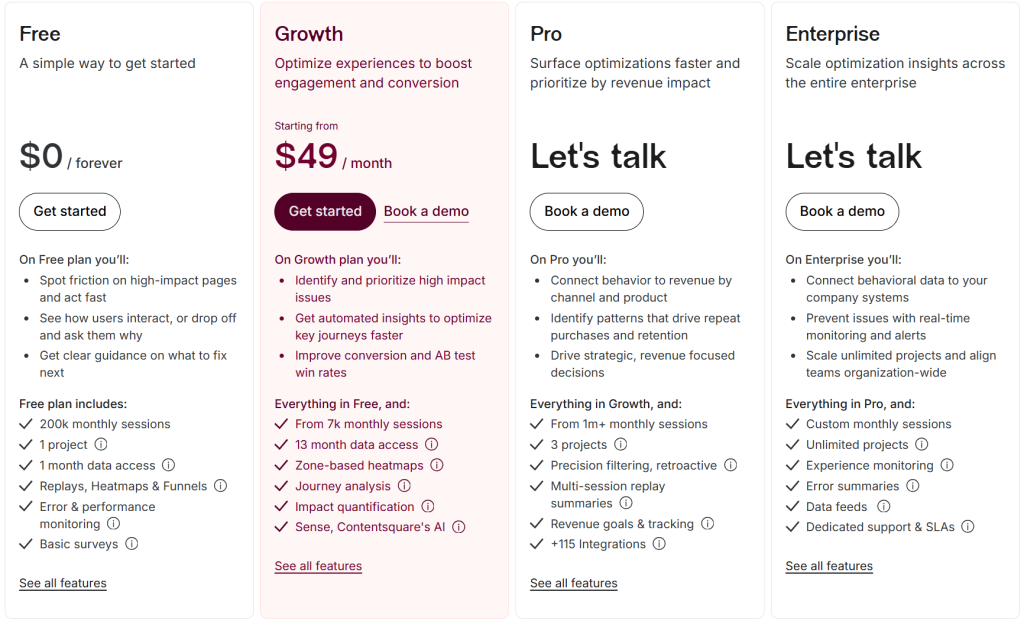
Hotjar pricing is a bit of a moving target right now. Hotjar is part of Contentsquare, and the “pricing” path often routes you into Contentsquare’s packaging, not a simple Hotjar-only grid. That means the exact plan names and limits you see can depend on whether you are buying the newer platform bundle or you are comparing the legacy Hotjar products.
If you are looking at Hotjar’s classic structure, pricing is modular: you choose a tier for each product based on the allowance you need. The three products are Observe (heatmaps and session replay), Ask (surveys and on-site feedback), and Engage (interviews and user tests). Each product has four tiers: Basic (free), Plus, Business, and Scale. You can upgrade just the products you need, but the total cost rises quickly when you combine multiple paid tiers.
Observe (heatmaps + session replay)
Observe is the behavior-tracking side of Hotjar. Pricing typically scales with how many user sessions you can capture. Public plan listings often show:
- Basic: Free, with a small daily session cap
- Plus: Entry paid tier (commonly listed around $39/month), with a higher daily session cap
- Business: Higher limits and more advanced capabilities (commonly listed around $99/month)
- Scale: Starts higher (commonly listed around $213/month) and is aimed at larger teams and governance needs
Ask (surveys + feedback widgets)
Ask is priced around how many survey and feedback responses you can collect per month. Two important details: Ask limits are not tied to your Observe session allowance, and response allowances reset on the first day of each month.
- Basic: Free, limited monthly responses
- Plus: A higher monthly response allowance (often listed at 250 responses/month)
- Business: More responses and advanced targeting and controls
- Scale: Custom, designed for higher-volume programs
Engage (interviews + user tests)
Engage is usually the most expensive module because it includes workflows for recruiting and running research, including access to a participant pool option. Plans are typically defined by how many interviews you can run each month and how many can come from the participant pool versus your own network.
- Basic: Free, limited interviews
- Plus and Business: Paid tiers that increase interview volume and research operations features
- Scale: Custom pricing for higher-volume programs
One last gotcha: “Hotjar cost” is rarely a single number. It is usually the sum of the modules you pay for (Observe, Ask, Engage), the tier you choose for each, and the usage limits you need for your traffic and research cadence.
Should You Switch from Hotjar?
Most teams don’t switch because they dislike Hotjar. They switch because their questions change: you go from “what’s confusing on this page?” to “which sessions, segments, and errors are driving the drop-off, and what do we fix first?”
| If this is your situation | Recommendation | Why |
|---|---|---|
| You’re web-first, your traffic is moderate, and you mainly need qualitative UX insight (heatmaps, replays, a few surveys). | Stay on Hotjar, and tighten your tagging and targeting. | Hotjar is well-suited for fast, lightweight insight when your questions are page and UX focused. |
| You keep hitting daily capture limits, and sampling makes it hard to catch rare, high-impact issues. | Evaluate alternatives that fit your volume and investigation workflow. | Hotjar uses daily session capture limits and sampling when you exceed them, which can reduce coverage for edge cases. |
| You need native mobile app replay. | Look elsewhere (Hotjar is web-only). | Hotjar is compatible with websites and web-based applications, not mobile apps. |
| You want replay tied directly to errors and technical debugging workflows. | Shortlist tools based on your engineering workflow. | Hotjar can capture JavaScript console errors via Console Tracking (plan dependent), but many teams still pair replay with dedicated error monitoring. |
| You want one place to connect replays, funnels, feedback, and errors for faster prioritization. | Consider switching if consolidation is the goal. | Consolidation reduces context switching and makes it easier to go from symptom to root cause to fix. |
If you stay on Hotjar: make sure you (1) define key journeys (signup, checkout, activation), (2) use consistent event naming, and (3) review sampling and limits before assuming you are seeing “all users.”
What We Liked
We hope you like our review so far. We wanted to share this insight with you so you can see if Hotjar fits your needs. Now, we’ll talk about what we like most about Hotjar.
1. Quick and easy installation
Hotjar offers a simple, easy-to-use tool that you can integrate into your website or product in minutes. It takes no time to set up and does not require extensive time and effort to use.
2. Integration options
Hotjar integration with other tools will help you find the insights you need faster. It helps you see all your data in one place. It eliminates the need for multiple software, which will save time and resources for your business.
You can integrate Hotjar with:
- Slack
- Segment
- Hubspot
- Optimize
- Omniconvert
- Optimizely
- Zapier
3. Low learning curve
The first and most important feature of Hotjar is its user-friendly interface. It has a low learning curve and enables you to understand and track user behavior fast.
It provides guides and tutorials that can help you understand how to use Hotjar and good customer support that will answer any questions you might have about the tool.
4. Visual reports
Hotjar helps you analyze your website’s traffic with an interactive dashboard that shows you real-time user behavior.
Visual data reporting shows you how people interact with your site and gives you a better idea of what they’re looking for. It provides insights on how to improve your user experience and keep the bounce rate low.
5. Continuous improvements
We like that the Hotjar team continues to improve their product. They add new features and improve the old ones, making sure that you’ll be able to use them in the future as well.
What We Didn’t Like
We like the idea behind Hotjar and think it has a lot of potential. However, it also has some downsides and features that it lacks. We think you need to know about them before making your sign-up decision.
1. Hotjar is not compatible with mobile apps
If you want to use Hotjar to collect user feedback for your mobile app, you’ll need to choose a different solution. You can use Hotjar primarily for websites or web apps, so it’s not compatible with mobile apps.
2. Daily capture limits can force sampling at scale
Hotjar has daily session capture limits for Heatmaps and Recordings. When you exceed that daily limit, Hotjar samples your traffic. That can be totally fine for directional UX insight, but it can make it harder to catch rare issues (like a payment edge case) unless you plan your targeting and filters carefully.
3. You can’t create custom reports
Hotjar’s reporting interface lacks some crucial features that can make your life easier. You can’t create custom reports that summarize data from multiple elements on the page or even create a custom report that focuses on one particular page element.
4. Surveys have basic customization options
Surveys can be a great way to get your customers’ feedback, but Hotjar doesn’t offer advanced customization options. Currently, you can only change the background color, button color, and font color or add your logo.
5. You may not capture 100% of visits
In practice, Hotjar often captures the majority of sessions, but it may not capture 100% of visitors, especially when you exceed daily capture limits and sampling kicks in. If your team assumes “no recording means no issue,” you can miss important edge cases.
Some reviews also state that Hotjar can go overboard with protecting data privacy by hiding a lot of information that is part of the app but not the customer’s data.
Reasons to Switch to FullSession Web Analytics Software
FullSession enables you to measure, monitor, and analyze your website’s effectiveness. You can also identify what types of content perform best on your site and segment it for improved targeting strategies.
FullSession lets you conduct a more in-depth analysis of your website visitors than HotJar.
Without affecting your site speed, it enables you to identify trends in user behavior and provides more detailed data (depending on your setup) to help you make strategic business decisions regarding your product development.
FullSession: Is it a Viable Hotjar Alternative?
All tools in one place to protect revenue and align teams.
Create a Seamless Digital User Experience with FullSession
Companies need to recognize that the customer is at the center of their business, and they need to make sure all aspects are in place for an exceptional user experience. In other words, the process from beginning to end of the user journey should feel natural and simple for your visitors.
Seamless digital customer experience is the result of a full-stack approach to web analytics. FullSession has combined different parts of this process and gives businesses a more complete view of their website’s performance.
It allows companies to make informed decisions about their marketing strategies by having access to information from all angles and without missing any detail regarding how people are experiencing their products or services online.
Learn from a Powerful Behavioral Analytics Tool
FullSession lets you discover the data that drives your business. The idea of using behavioral analytics tools is to identify users’ behavior by analyzing their online interactions and pinpointing growth opportunities.
You can gain insight into which pages users access most often, where they come from, what links they click on, and what they do when they get there.
You would be able to see the exact path they took on your website, how long it took them to make their decision, and what products or services caught their attention.
Start a free trial now.
FullSession Features
It’s often said that usability testing is an “all-or-nothing” process, but in reality, it’s a process of revisions that includes many steps:
- Conducting usability testing
- Evaluating findings and working to address them
- Studying the results
- Repeating for as many rounds as necessary
Making simple changes to your web app can make it more comfortable for your users with no major impact on your site performance. It is where FullSession comes in handy. We provide you with the tools to test the most challenging ideas with ease.
Continue reading and learn more about our current features for understanding user behavior.
1. Session recording and session replay
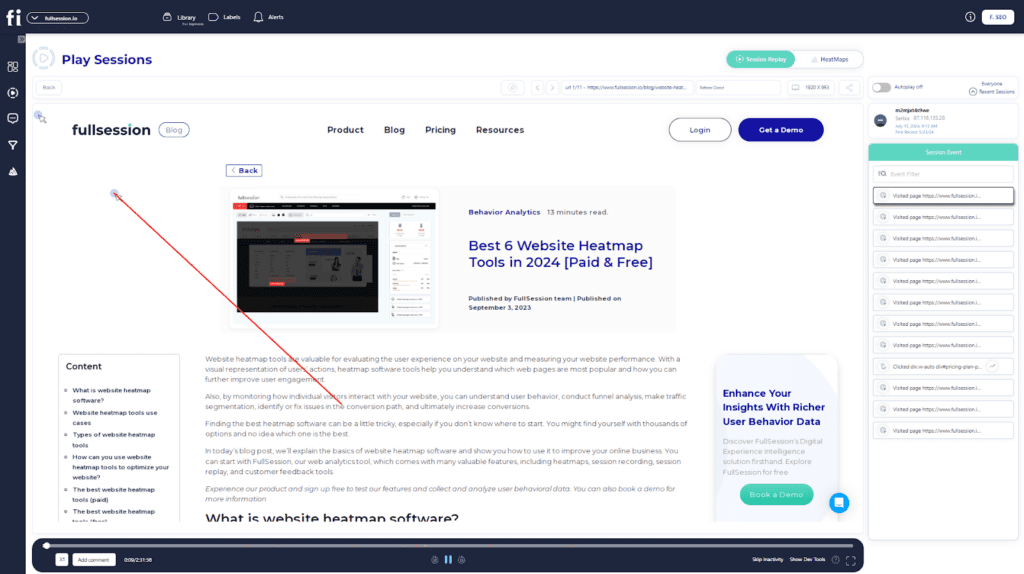
Session recording and replay tools enable you to understand how customers navigate various web pages. In real time, you can identify funnel drop-offs and observe significant customer actions like button clicks, scrolls, hovers, and mouse movement.
With our session recording and replays, you will get access to data such as:
- User location and IP address
- Clicked URL
- Referrals
- Visited pages
- Average time on page
- Total active time on pages
- Session list
- Session event
What’s best is that you can skip inactivity, pause, or speed up the session replay to save time while conducting your analysis. You can leave your comments, watch a heatmap, or share the session recording with your team, improving collaboration on the project.
2. Interactive heatmaps
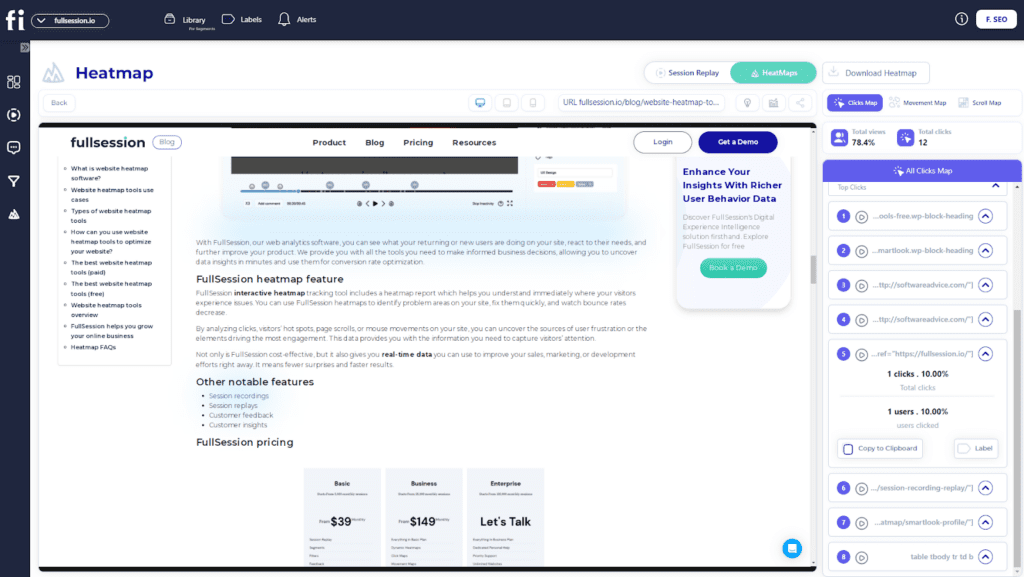
An interactive heatmap is a visual representation of user activity on your website. It shows areas of high concentration with colors or symbols that stand out, often to indicate areas of strong interest. It helps you determine where users click and spend the most time on your site.
With FullSession interactive heatmaps, you can:
- Visualize heatmap data on different devices
- See the URL the user visited
- Track the number of total views and total clicks
- Watch error clicks
- Visualize rage clicks
- Monitor dead clicks
- See the average load time on the page
- See the average time on the page
- Track the number of users that visited the page
Also, you can switch between mouse movement, click, and scroll maps by clicking on the icons in the top right menu.
3. Advanced filtering and segmentation
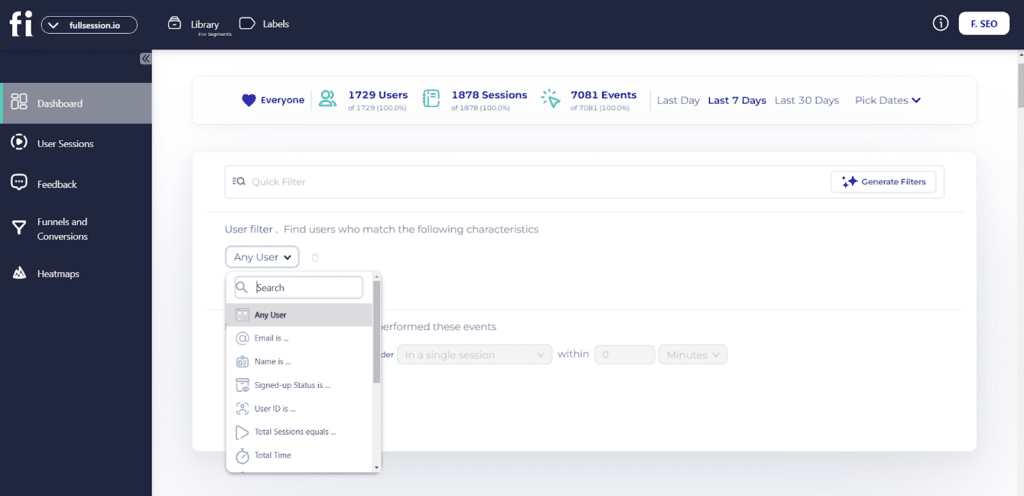
FullSession’s advanced segmentation and filtering options allow you to create unique customer segments, filter important user events, and identify questionable user recordings and session replays.
4. Insights
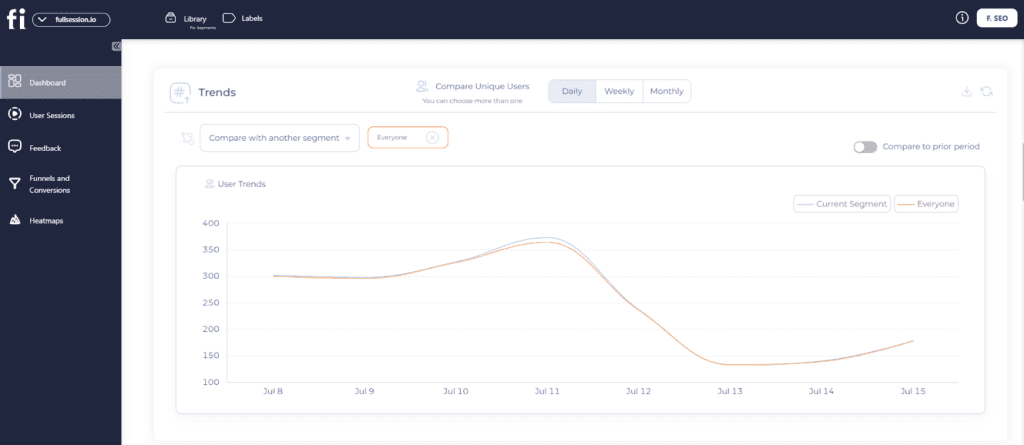
FullSession presents detailed insights based on a comprehensive analysis of customer behavioral data. Our in-depth insights help you visualize friction points affecting conversion rates.
5. Customer feedback forms
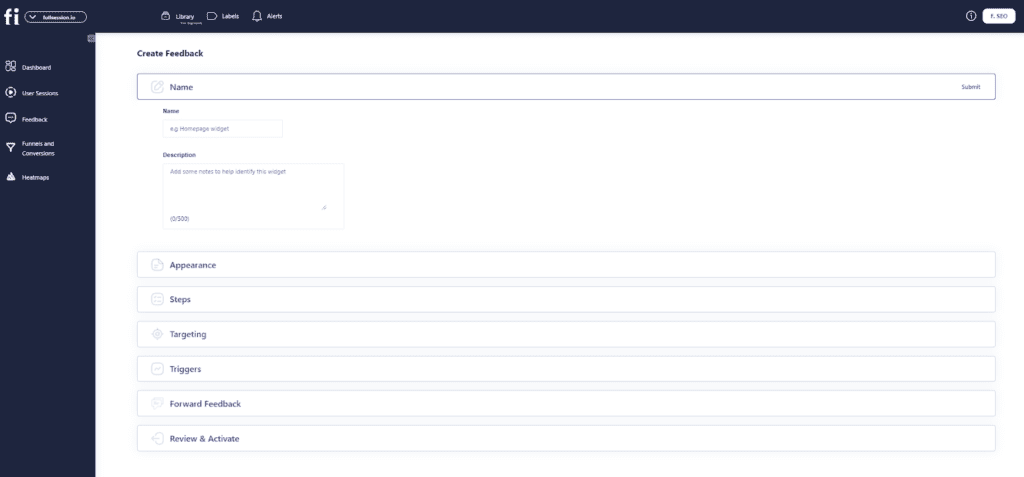
Customer feedback forms help you ask users about their digital experience in real time, allowing you to improve your product accordingly.
You can see the user ID, URL the user visited, comment they left, the browser they used, and the date of the feedback.
Also, you can watch a session recording that’s connected to the feedback to understand what happened and learn why the user had a negative experience.
Start a free trial now.
6. Notes
Notes allow you to record key findings about customer behavior and share them with your team. This allows you to assess challenging areas and improve your product development and strategy.
7. Funnels and conversions
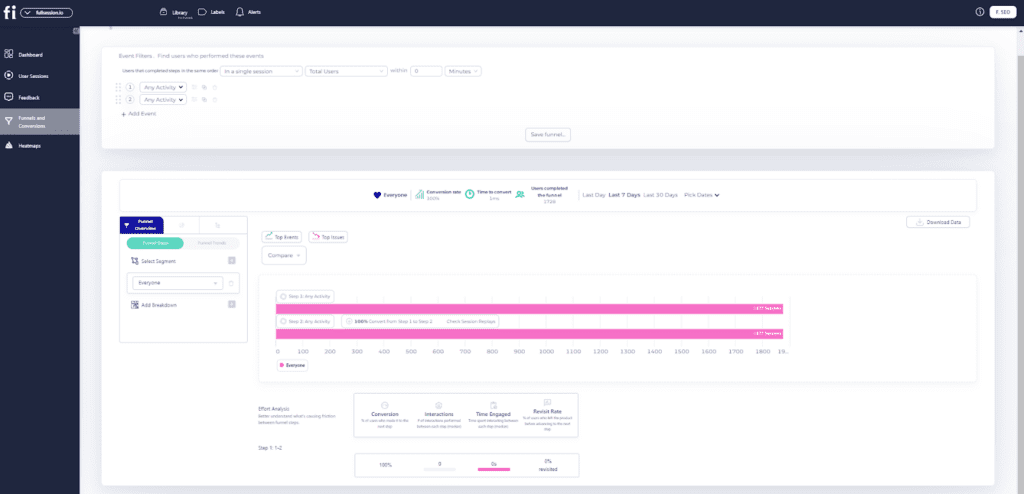
The FullSession feature is your key to achieving conversion goals. It provides precise tracking with metrics like conversion time and user percentages. This offers valuable insights into your marketing strategy, helping you identify successful campaigns and areas needing improvement.
With the funnels and conversions feature, you can closely monitor and refine each stage of your conversion funnel, turning data into actionable insights.
You can track conversion goals and user percentages to see what’s effective, then refine your marketing strategy to enhance your best campaigns.
Visualizing user behavior is straightforward. Understand exactly where users convert or drop off, spot trends and seasonal changes, and identify actions driving conversions. FullSession helps you address issues causing drop-offs and reduce user frustration.
The advanced reporting tools provide a detailed overview of user interactions and engagement metrics, ensuring you have a comprehensive understanding of your audience.
8. Error analysis
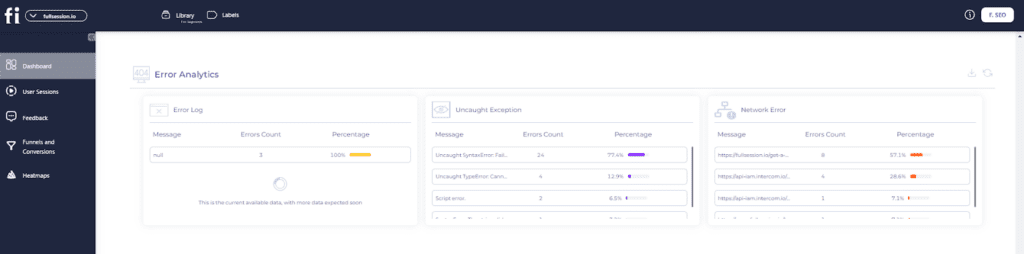
The error analysis feature identifies, analyzes, and resolves various errors impacting user experience. By using data on error clicks, network errors, console errors, error logs, and uncaught exceptions, FullSession provides insights to improve reliability and user satisfaction.
It helps detect non-responsive elements, monitor connectivity issues, reveal underlying code problems, and capture detailed error logs for effective debugging. The integration with Slack for real-time alerts ensures swift issue resolution.
This comprehensive approach leads to a smoother user journey, higher conversion rates, and improved product reliability.
Why Choose FullSession Over Hotjar?
It’s really hard to get a sense of what you do and don’t do well just by looking at your product. Since we’re serious about improving our solution, we deep-dived into Hotjar and compared it with FullSession.
Here is what we do better:
- FullSession uses more sophisticated analytics tools to help you identify and eliminate friction points. This will improve your conversion rate, increase revenue, save costs, and improve customer retention.
- FullSession helps you understand which steps in the sales funnel are critical. You can see exactly how many leads you have converted and how many have dropped out.
- FullSession has advanced filtering options, so you can find sessions that interest you and do more research. This will help you create a better experience for your customers.
- FullSession will help you identify major events inside one session and save you time by getting to the essentials.
- FullSession’s intuitive user interface is easy to use, even if your tech expertise is limited.
We found that your website performance can be significantly slower when you use Hotjar. If you’re comparing alternatives, include performance overhead as an explicit evaluation criterion alongside privacy controls, capture limits, and investigation workflow.
In contrast, FullSession empowers you to determine the right customer experience without affecting the site’s performance.
Turn User Behavior into Growth Opportunities
Visualize, analyze, and optimize with FullSession. Ensure peak performance as you grow.
FullSession Pricing Plans
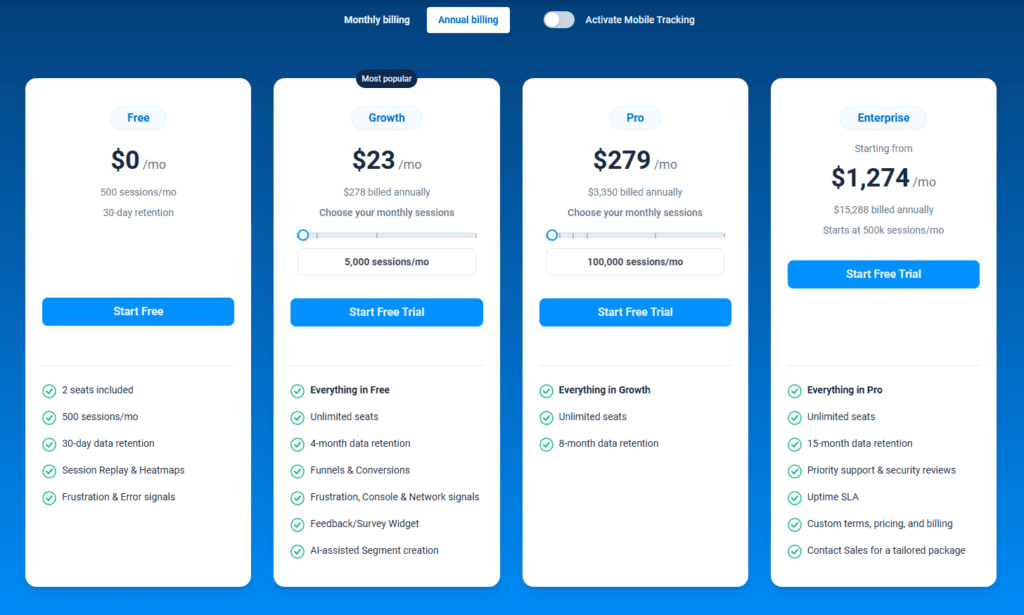
The FullSession platform offers a 14-day free trial and three paid plans: Starter, Business, and Enterprise. A yearly subscription can save you up to 20%!
Here are more details on each plan.
- The Free plan is available at $0/month and lets you track up to 500 sessions per month with 30 days of data retention, making it ideal for testing core features like session replay, heatmaps, and frustration signals.
- The Growth Plan starts from $23/month (billed annually, $276/year) for 5,000 sessions/month – with flexible tiers up to 50,000 sessions/month. Includes 4 months of data retention plus advanced features like funnels & conversion analysis, feedback widgets, and AI-assisted segment creation.
- The Pro Plan starts from $279/month (billed annually, $3,350/year) for 100,000 sessions/month – with flexible tiers up to 750,000 sessions/month. It includes everything in the Growth plan, plus unlimited seats and 8-month data retention for larger teams that need deeper historical insights.
- The Enterprise plan starts from $1,274/month when billed annually ($15,288/year) and is designed for large-scale needs with 500,000+ sessions per month, 15 months of data retention, priority support, uptime SLA, security reviews, and fully customized pricing and terms.
See What FullSession Can Do Today
Setting up your analytics dashboard with FullSession takes less than 5 minutes, and it’s completely free!
Get a demo now.
FAQs About Hotjar
What is the disadvantage of Hotjar?
Hotjar’s disadvantages include limited features in its free plan, potential data privacy concerns that require careful configuration, possible performance impacts on your website, a complex setup process, and fewer third-party integrations compared to some other analytics tools.
Is Hotjar better than Google Analytics?
Hotjar and Google Analytics serve different purposes and can complement each other. Google Analytics excels in providing quantitative data on user behavior and website performance, while Hotjar offers qualitative insights through tools like heatmaps, session recordings, and user feedback. Using both tools together can provide a comprehensive view of your website’s user experience.
What is Hotjar used for?
Hotjar improves website user experience by providing insights through heatmaps that show where users click and scroll, session recordings that allow you to watch individual user interactions, feedback polls and surveys for direct user input, conversion funnel analysis to identify drop-off points, and form analysis to understand user interactions with site forms.
Is Hotjar secure?
Hotjar provides security and privacy controls (for example, data handling settings and access controls), but “secure” depends on how you configure data capture, masking, and who has access inside your organization. Treat it like any analytics tool: align configuration with your compliance requirements and internal policies.
Does Hotjar record all visits?
Not always. Hotjar often captures the majority of sessions, but it may not capture 100% of visitors. Each site has a daily session capture limit, and when you exceed it, Hotjar samples traffic to distribute capture across the day.
How do you use Hotjar effectively?
You can use Hotjar for conversion rate optimization and conversion research. With it, you can measure and optimize conversion rates and sales funnels, and you can improve any type of website, from eCommerce websites to startup websites.
Who uses Hotjar?
It’s best for large enterprises that need advanced functionalities or employees working as Product Managers, Product Designers, or Researchers.


Mohamed oversees operations and finance at FullSession and has contributed to the company’s UX analytics knowledge base.